Using an analogy method, it can be assumed that must exist
the closed mechanical system, capable of changing its the location only with the aid of the internal forces, without the
external action.
Analogy method.
Method of investigating any process, by the replacement by
its process, described by the same differential equation,
like the studied process.
(the explanatory dictionary of physical terms)
Analogy between rotatory and forward
motions
" I value the skill to construct the analogies,
which, if they are daring and reasonable, derive us beyond the limits of the
fact that nature wished to us to open, making it possible to foresee facts even
before we will see them. ".
Zh.L.D'Alamber
Between the motion of solid body around the fixed axis and the motion of
separate material point (or by forward motion of body) there is a close and far
reaching analogy. A similar value from the kinematics of the rotation of solid
body corresponds to each linear value from the kinematics of point. To
coordinate
s corresponds the angle
φ , the linear
speed
v - the angular velocity w , to linear (tangential)
acceleration a - the angular acceleration
ε .
Comparative parameters of the motion:
Forward motion
The rotary motion
Displacement
S
The angular displacement
φ
Linear speed
Angular velocity
Acceleration
The angular acceleration
Mass
m
Moment of the inertia
I
Pulse
Moment of momentum
Force
F
Moment of the force
M
Table can be continued and further.
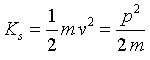
Work:
Kinetic energy
Expressions for the rotary motion resemble the appropriate expressions of
forward motion. They are obtained from the latter by the formal
replacement of m → I , v → w , p → L
The represented table cannot pretend to full weight of the scope of
analogous values.
For rotatory and forward motions are formulated the analogous laws:
Law of momentum conservation (LMC
)
,
with Fext
= 0
Law of conservation of momentum of
pulse (LCMP
)
,
with Mext
= 0
These laws are formulated as follows:
"if vector sum of the external forces, which act on the system, is equal to
zero, then the pulse of system remains, i.e., does not change in the course of
time. In particular, this occurs, when system is locked "
"if the moment of external forces relative to fixed beginning
o is equal to zero, then the moment of momentum of system relative to the
same beginning remains time-constant"
[ D.V.Sivukhin. General course the physicists
of t..I Mechanics ]
In the classical mechanics the law of momentum
conservation usually is derived as the consequence of Newton's law. However,
this law of conservation is accurate in cases when Newtonian mechanics is not
applied (relativistic physics, quantum mechanics). It can be obtained as the
consequence of intuitive- accurate assertion about the fact that the properties
of our peace will not change, if all its objects (or reference point!) to move
for the certain vector
R. At present there does not exist any experimental facts, which
testify about the non fulfillment of the law of momentum conservation.
The law of conservation of momentum of pulse is the consequence of assertion
about the fact that the properties of the surrounding peace do not change with
the turnings (or the turning of frame of reference) in the space. The moment of
momentum of the system of the point bodies L
is defined as the sum of the moments of each of the points and remains in the
time with the condition of equality to zero moments of external forces.
Given laws relate tothe global laws of conservation.
Answer to the natural question of why are valid the laws of conservation, in
physics was found comparatively recently. It turned out that the laws
of conservation appear in the systems when in them certain elements of
symmetry are present. (element of the symmetry of system is called any
conversion, that transfer system into itself, i.e. not changing it).
German mathematician By Emmi Noether in 1918 mathematically proved the
connection between the laws of conservation and the symmetry, which the laws of
nature possess in physics. In the simplified formulation the theorem Noether
says, that if the properties of system do not change from any conversion of
variables, then to this corresponds a certain law of conservation.
Theorem Noether - simplest and universal means, which makes it possible to find
the laws of conservation in the classical mechanics, quantum mechanics, field
theory, etc.
This is how appear proofs LMC and LCMP on the basis of the property of the
symmetry of the space [ Of d.V.Sivukhin. General course the
physicists of t..I Of Mechanic.(gl..Y, 38) ]:
...4. Turning to the proof of the law of momentum conservation. Let us assume
that the mechanical system is locked. All forces F1 , F2
..., the acting on the material points systems, are forces internal, there are
no external forces. Let us transfer system from arbitrary position 1 to another
arbitrary position 2 so that all its material points would undergo one and the
same displacement r, and besides so that their speeds would remain before
in the value and the direction. In view of the uniformity of space, to this
displacement does not be required the expenditures of work. But this work is the
scalar product (F1 + F2 +...)r . It
means, it is equal to zero, whatever displacement r. Hence
it follows that for the closed system F1 +F2
+... of =0. A this is the very thing condition, with fulfilling of which of
second Newton's law is obtained the law of momentum conservation.
5. The law of conservation of momentum of pulse for the closed system proves
exactly so. Using isotropy of space, it is possible to prove that the vector sum
of the moments of the internal forces, which act in the system, is equal to
zero: M1 +M2 +... =0. hence immediately follows the law in
question.
As is evident, proofs are very similar.
With the entire similarity of progressive and rotary motion, they have
differences.
One of them is examined in this article.
There is a phenomenon, which enters, it would seem, in the contradiction with
LCMP.
The closed mechanical system can be turned to any angle
with the aid of some internal forces alone.
And not only can it be rotated by a certain angle, but it can also be made to revolve continuously.
How it is possible to turn mechanical system with the aid of some internal
forces alone?
Let us examine an example.
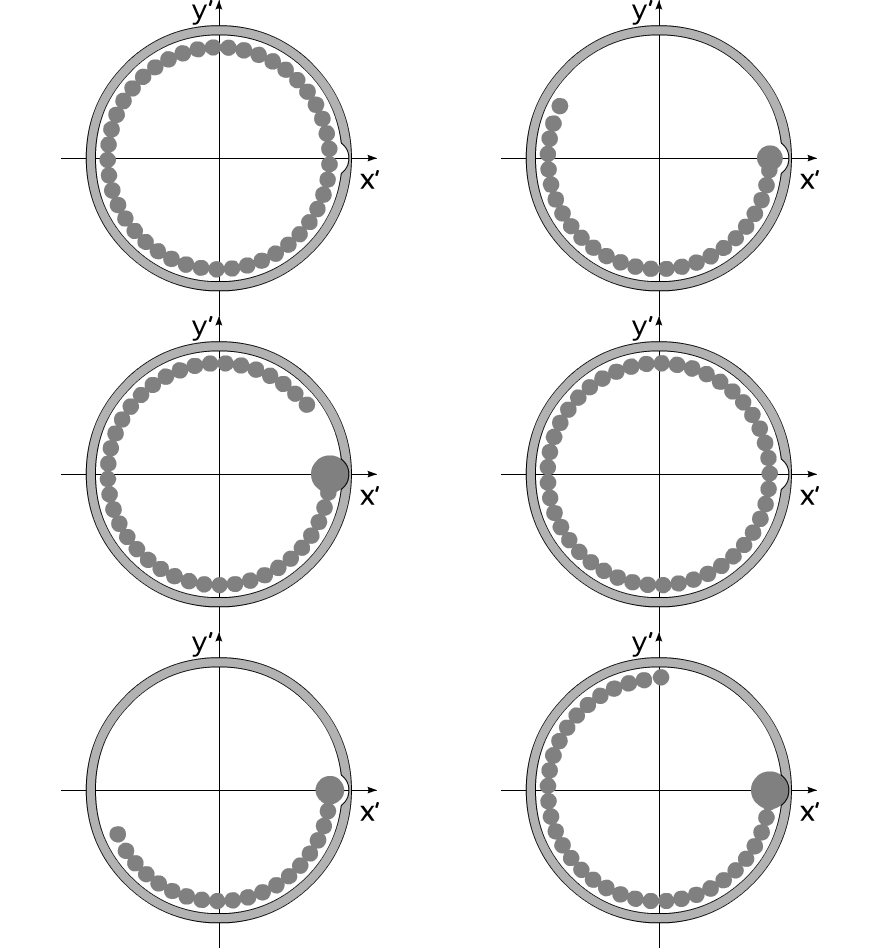
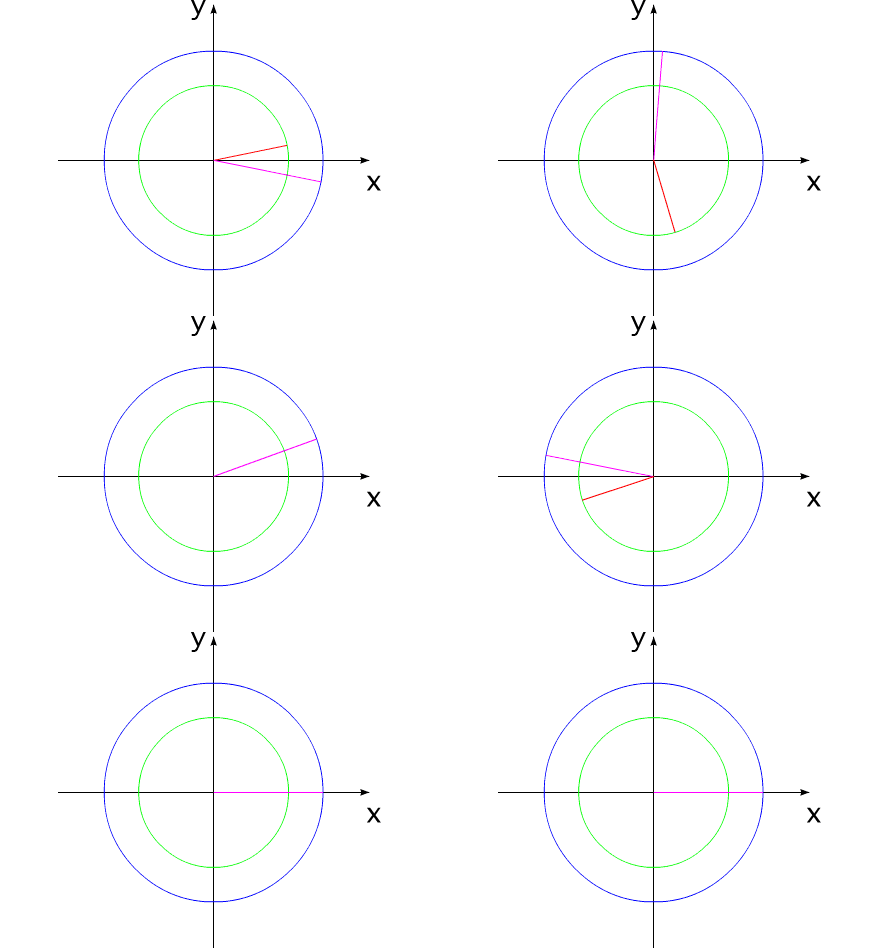
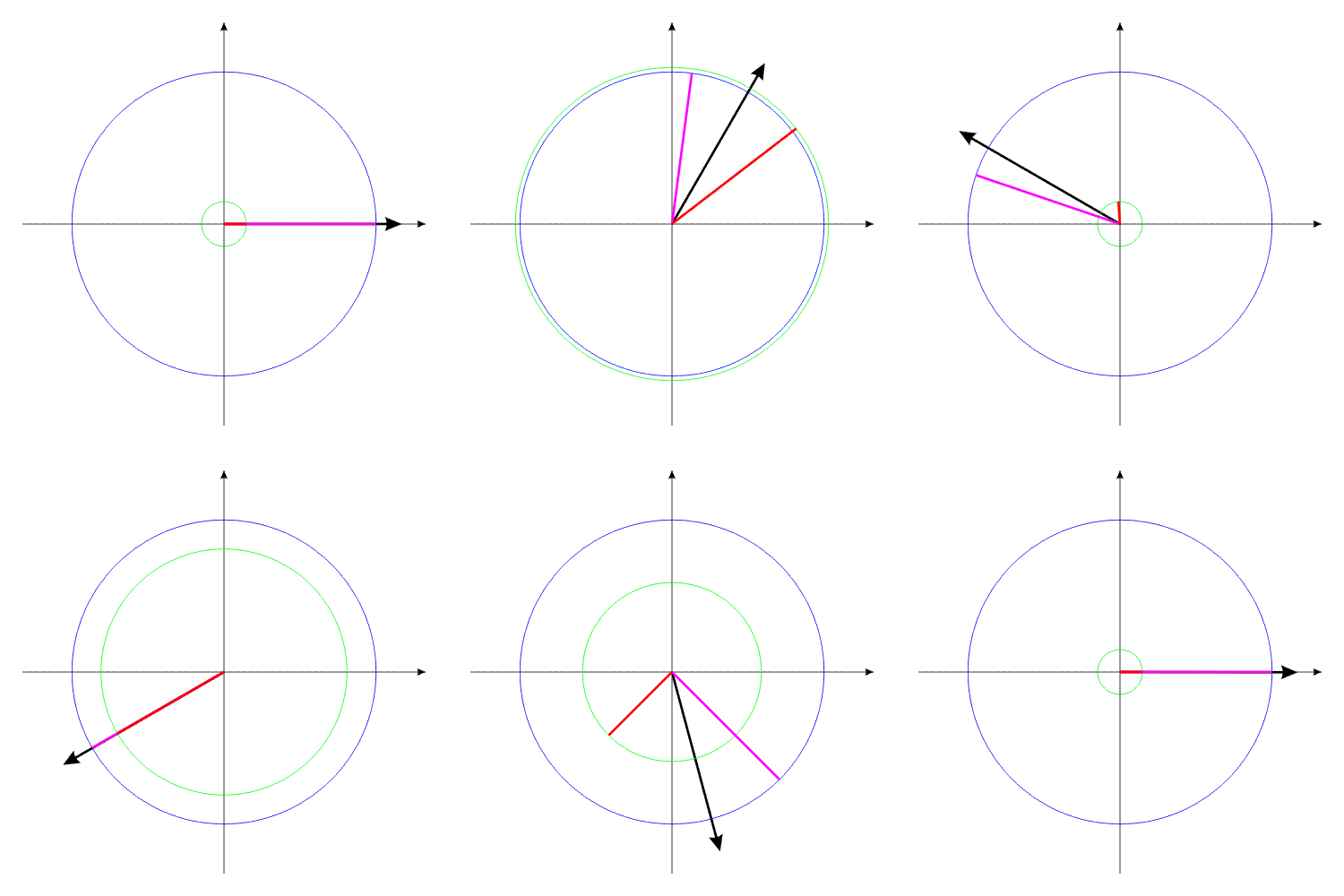
Let us assume we have two balanced bodies, fixed coaxially. Bodies have the
capability to revolve relative to each other. One of the bodies (green outline,
a red radius) is capable of changing its geometric dimensions, changing, thus,
its moment of inertia (Iv). Let us assume the maximum value
of Iv max of this body corresponds to value of Ic
of the second body (dark-blue outline, a purple radius). The minimum value of
Iv min is considerably lower than Iv max.
Let us examine the cycle of motions of this
mechanical system.
Fig.1
Body with by variable Iv acquires maximum geometric sizes.
(due to the internal energy, it understands).
Due to the same internal energy let us create the
internal torque, which acts equally on both bodies. Under the action of this
moment, body they begin to be turned in opposite directions.
It is possible to stop motion of both bodies at any
moment of time. Since the moments of inertia of both bodies are equal, angular
positions both bodies will engage identical (in the absolute value). At the
moment of stop, the angular position of entire system remained before. Will not
change this angular position and when we will begin to change geometric
dimensions of one of the bodies.
After decreasing the geometric dimension, and
respectively the moment of inertia of one of the bodies, let us try to reduce
both bodies to the previous angular positions of these bodies, with the aid of
the power moment, directed to other side.
Here and occurs interesting.
Since the moments of inertia of both bodies are
already different, both bodies it is turned to the different angles. It is
possible to again increase dimensions of one of the bodies. System will again be
such as before.
Almost...
In reality, entire system proves to be that turned to a certain angle. The value
of this angle is proportional to the difference of the moments of the inertia of
two bodies.
These cycle of motions can be repeated.
And it occurs that the system revolves!
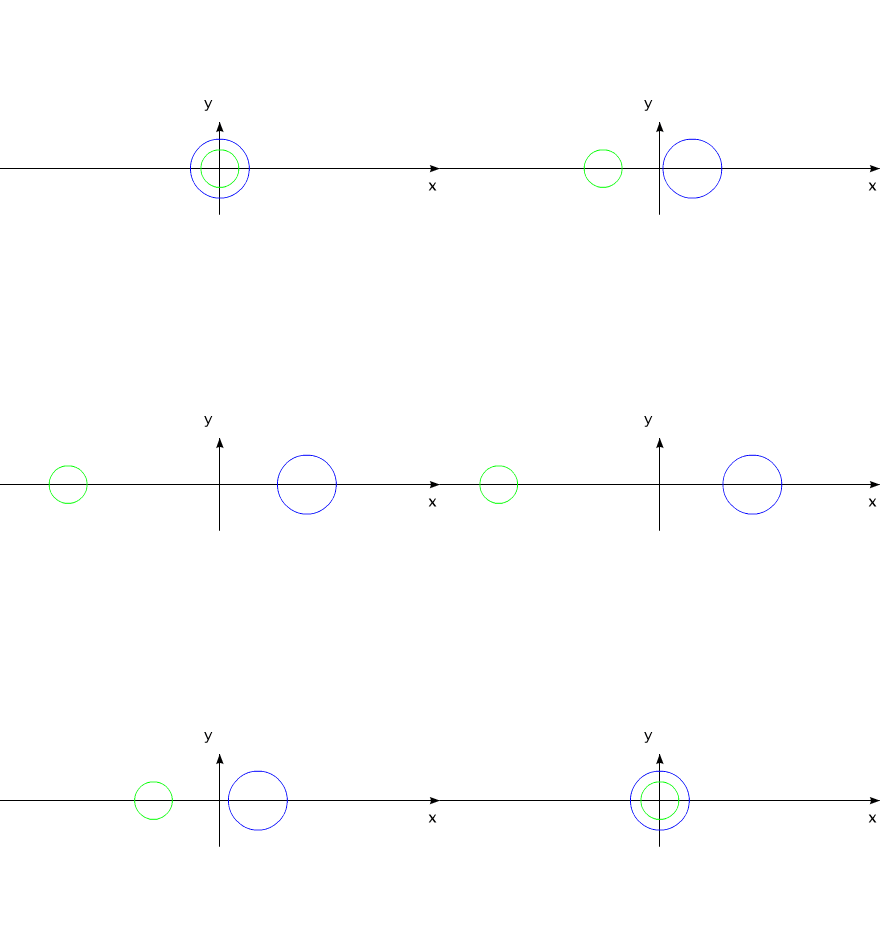
Fig.2
Moreover, it revolves entirely well!
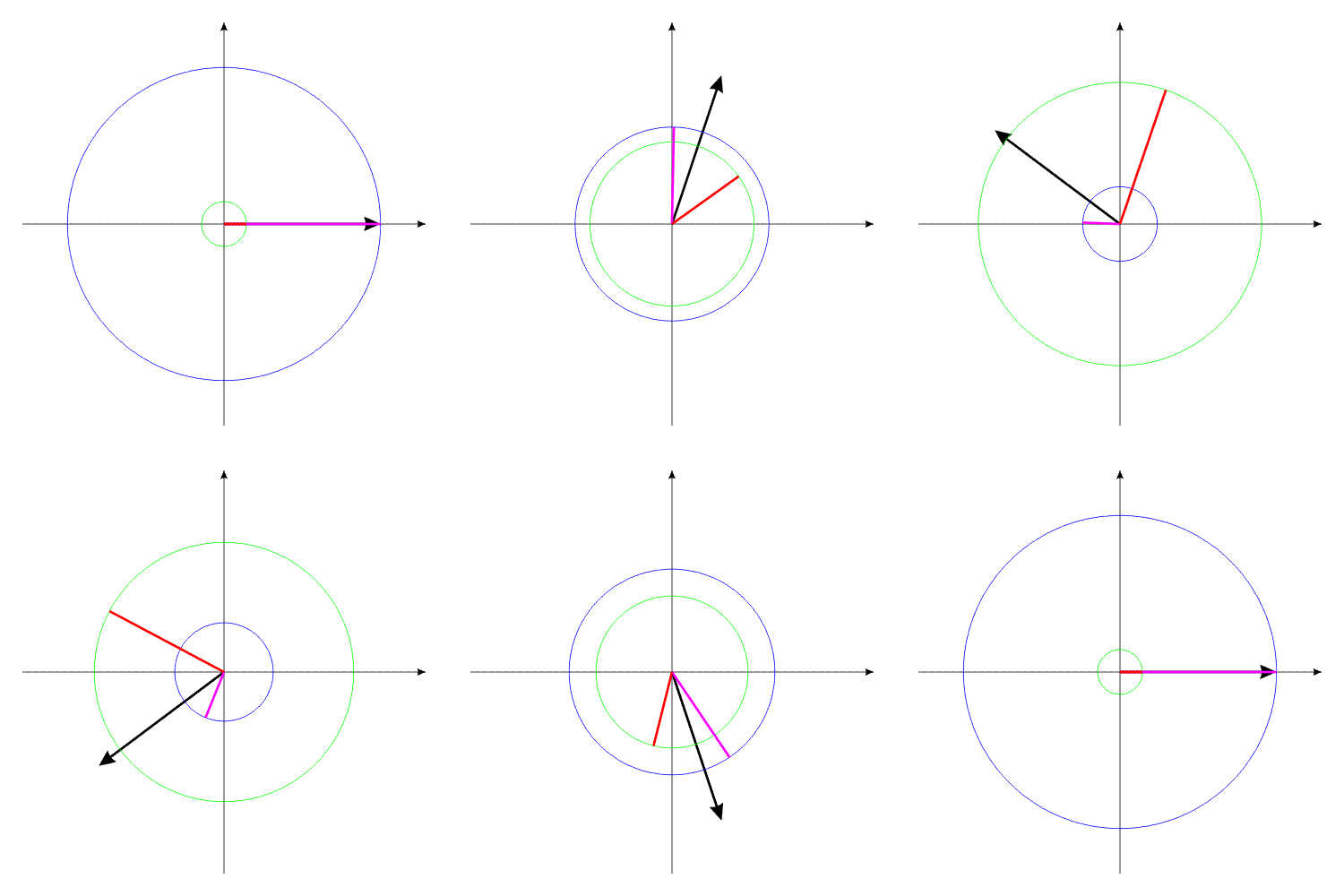
Let us assume the components of system change their geometric dimensions in such
a way that total moment of the inertia of entire system remains without the
changes.
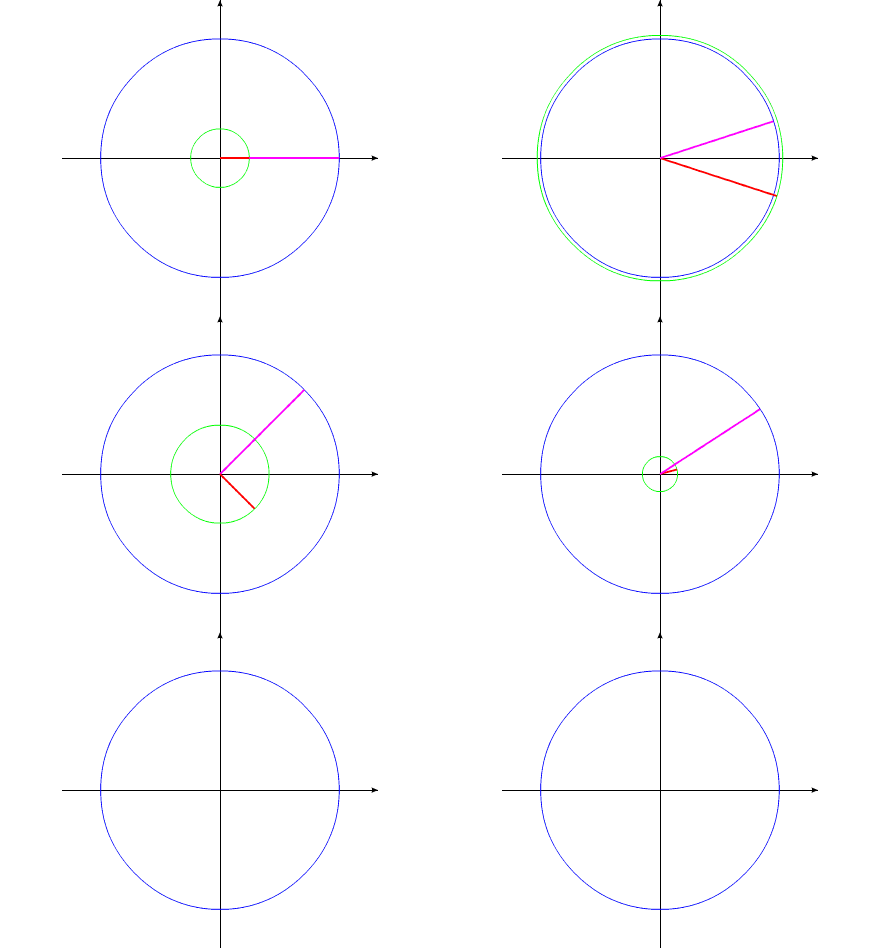
Depicted on
fig3
system can be examined as interaction of bodies with the variable torque of
inertia, with the constant mass and constant moment of the inertia of
entire system as a whole.
Fig.3
The system, as shown in animated
fig3, accomplishes the complete revolution in 16
seconds.
It is possible even to calculate the "speed" of rotation of this system:
rad/s
But, in reality, it cannot be spoken about this value as about the "speed of
rotation of system". More right it will sound: the "rate of the process of
changing the angular position", since value wφit is not the measure of the kinetic state of this system, since
kinetic energy of system does not change.
The motion examined is inertia-free. If we stop the relative displacements of
components inside the closed system, motion wφ immediately
it ceases. To valuewφmost of all approaches name precession.
In the process of a similar "rotation" is not disrupted
LCMP, since
total moment of momentum of all components of system, at each moment of time, is
equal to zero.
At the same time it is possible to determine the moment of force, equivalent to
the external moment of force, which should have been applied to the system in
order to cause a similar displacement.
Specifically, - equivalent, since for the situation in question, the
external power moment is equal to zero.
The conclusions, which can be made on the basis of the given example:
within the framework
of the law of conservation of momentum of pulse it is possible to change the
angular coordinates of the closed mechanical system only due to the internal
forces;
important role during the
organization of angular displacement with the aid of the internal forces, plays
a change in the moment of the inertia of the components of system;
the angular displacement of
entire system - is inertia-free;
the rate of change in the
angular coordinates, having a dimensionality the same as angular velocity, by
speed can be counted only formally.
Let us return to the proofs LMC and LCMP on the basis of the property of
the symmetry of space.
Proofs are constructed on the assumption of a certain displacement of system
(turning, in the case LCMP).
But in the case of the revolving system, this displacement actually can be
produced due to the internal energy.
I.e., displacement not is virtual, but it is completely actual.
In the large table of analogous expressions for the rotatory and progressive
displacements, appears the large empty cell:
Displacement due to the internal
forces
?
Turning due to the internal
forces
φ≠constwith:
∑Li=0,
,
Mext
= 0,
Displacement due to the internal forces? In the case with the progressive
displacement, such it seems inadmissibly. On this score even there is a "theorem
about the motion of the center of masses", which, it is at first glance, does
not allow the similar displacement: "the centre of the masses of system move as the material point,
whose mass is equal to the summary mass of entire system, and the acting force -
to vector sum of all external forces, which act on the system".
It does mean, I do be empty cell in the table it must occupy this
theorem?
But analogy method makes it possible to assume that and for the linearly
moving system, must exist the possibilities, inherent in the revolving system.
This assumption is constructed on the analogy of the equation of motions of
rotatory and forward motions.
Cell must be filled, approximately, with the following
content:
Displacement due to the internal
forces
s
≠constwith:∑
pi=0,
,
Fext
= 0
This expression is obtained as a result of the formal
replacement
φ→S
,
M→F , L→p
is possible existence of mechanical system, which is capable of
linearly being moved only due to the internal forces;
linear displacement can be achieved due to the change in the parameter,
analogous to the moment of inertia, namely - mass;
the linear displacement of entire system must be inertia-free;
the "speed" of the displacement of a similar system not will be the
measure of kinetic state, i.e., in the process of displacement the total impulse
of the components of system will remain constant.
Since the "speed" during this motion is formal value, its appearance cannot
indicate of the disturbance of the "theorems about the motion of the centre of
masses".
The properties of mechanical system, by the
name "varipend", most fully satisfy the enumerated assumptions.
Fig.4
Name "varipend" is obtained from the confluence of two words:
varipend =variable +pendulum .
In the process of displacing the working mass and its stoppage in the "housing"
of system, the motion of the centre of the masses of work substance can be
examined as the pendulum motion
of variable length and variable mass. (in the coordinate system,
connected with the "housing")
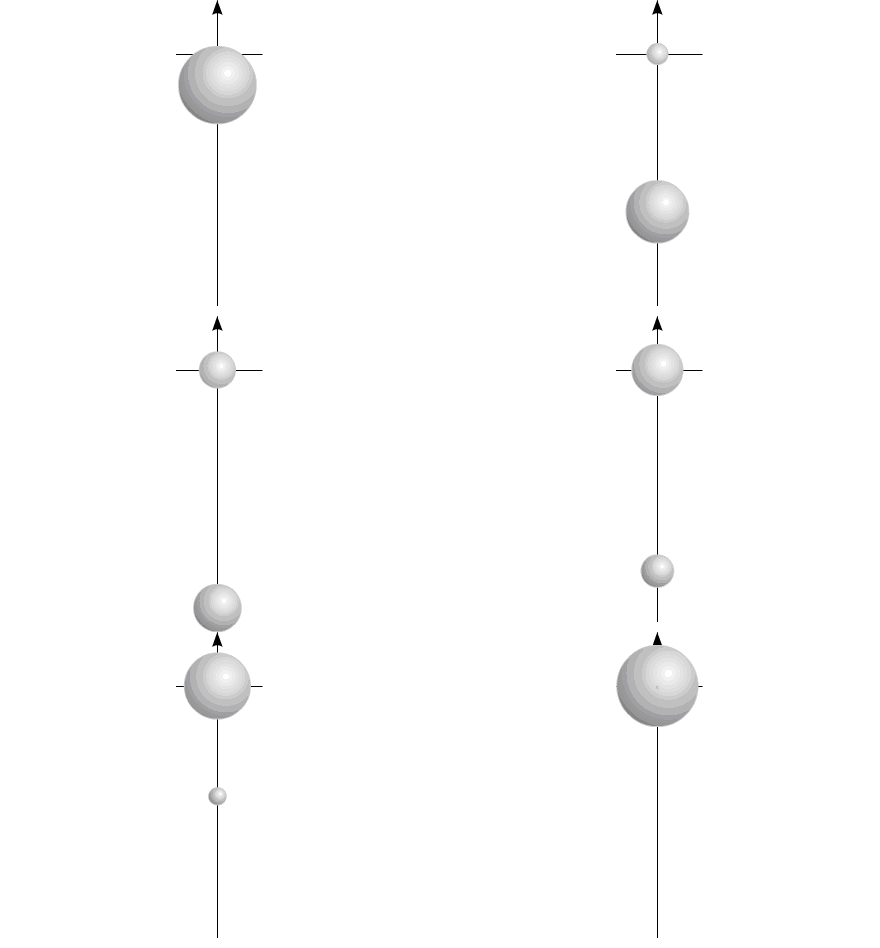
Fig.5
Or, in the projection on one coordinate:
(this case of displacing the centre of
masses it is possible with the displacement of two working masses, which revolve
in opposite
directions.)
Fig.6
The changing size of components in the figure symbolizes a
change in the mass of the elements of the system:
the work substance,
which decreases its mass during the operating cycle,
and the housing of
system, which increases its mass due to the connection of the particles of work
substance.
With constant overall mass, entire system can be examined as
interaction of the components of variable mass.
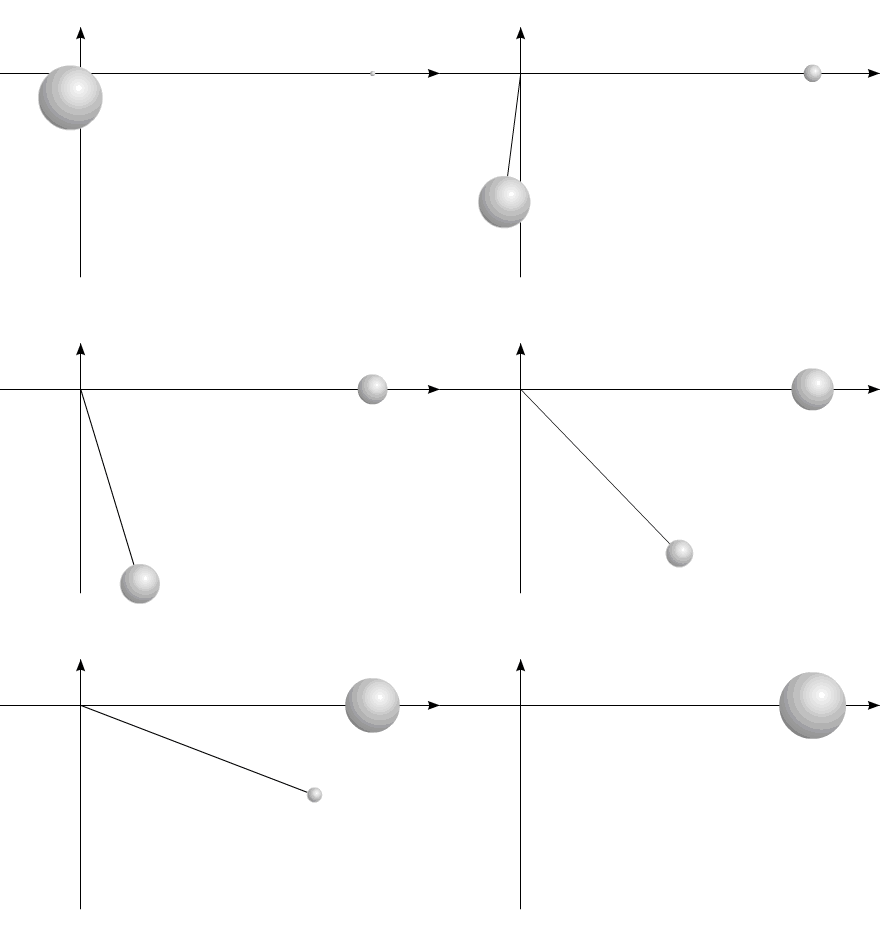
In one of the calculations of the displacement of "varipend" is
used the equation of motion of the body of variable mass - equation of Meshcherski'y.
In
Fig.4 is represented setting task "varipend".
Solution of this task appears as follows:
Blue track the movement of the body(case).
Red - movingchange center of mass of the all system.
Fig.7
If we examine "varipend" in the absolute coordinate system, then with the
repetition of the internal cycles of the displacement of work substance,
"varipend" continuously changes its attitude:
Fig.8
It is possible to conduct analogy with
figure 3.
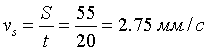
System, depicted on fig.8, are moved up to the
distance of 55 mm in 20 seconds.
It would seem, it is possible to calculate the speed of "varipend":
But, since in the process of displacement the total impulse of system remains
constant, value vs
will be formal value, which determines only changes in the coordinates of the
centre of masses. This value is in no way connected with the pulse of entire
system.
If we stop the relative displacement of working mass inside the closed
mechanical system, entire system will instantly end its motionend changing its coordinates.
The mathematical calculations, which describe the assumed properties of
mechanical system by the name "varipend", can be looked with the address: https://varipend
Note
In many training publications on theoretical mechanics, are given examples of
the turning of the closed mechanical system due to the internal forces.
For example, man is capable to turn himself on Zhukovskiy's bench, accomplishing
some rotations by hands.
Turning massive bodies in the space vehicle, the angular orientation of these
apparatuses is produced.
Cosmonaut, find in weightlessness, also can turn his housing, after completing
several revolutions by hand.
However, in reality, in all given examples the turning of system is absent.
The given examples demonstrate, if one may put it that way, the "theorem about
the retention of the angular position" of the closed mechanical system.
I will attempt to explain my words.
If the moments of the inertia of the components of system do not change and
external moment is absent, then it is possible to write down:
I1φ1(t)+I2φ2(t)=0
This is easy to verify.
Let us assume we is pivoted two bodies relative to each other.
If we after stoppage turn components in the opposite side, system will
compulsorily occupy accurately the same angular position, which was at the
initial moment of time.
Fig.9
To Fig.9 two bodies first are turned to a certain angle, and then are turned in
the opposite side to accurately the same angles. In this case the system
occupies its previous angular position.
The illusion of the turning of entire system appears because the angular
function is periodical. As soon as angular positions of components they exceed
the angle of 2π appears sensation, that the system turned itself. But this is not so.
Certainly, angles it is necessary to continue to count off, also, with exceeding
of the angle of 2π.
The case of two-body interaction can serve as an analogous example of
linear displacement:
Fig.10
Bodies can they will be removed from each other, due to the internal forces,
approach, but the relationship will be always carried out for this system:
This is - corollary about the motion of the centre of masses....
But as the same expressions for the conditions of the system, which consists
of the components with the variable torque of inertia (variable mass) will
appear?:
"
... analogy is the specific case of symmetry, the special form of the unity of
retention and change. Consequently, to use in the analysis an analogy method,
means to act in accordance with the principle of symmetry. Analogy not only is
permitted, but also is necessary in the knowledge of nature of things...."[
Ovchinnikov N.F. Principles retention. M., 1966 ]
It is
protected by the legislation of the Russian Federation on the copyrights.
No part of the site can be reproduced in to any form and any means without the
written permission of the owner of copyrights.







 ,
with Fext
= 0
 ,
with Mext
= 0
 rad/s